

Experience the future of disaster response:
Live Demonstrations & Stakeholders Workshop


The GEXTRECS project is getting closer to its final stage, and we invite GOVSATCOM End-Users, Competent GOVSATCOM Authorities and interested stakeholders to witness the results of our intensive work!
GEXTRECS (GOVSATCOM Extreme Events Crisis Management Service) is a Horizon Europe-funded initiative developing an integrated EU GOVSATCOM Crisis Management Service Pack. Our goal is to ensure seamless, secure, and rapidly deployable space-based communications during massive disaster and emergency situation.
Join us on 23 October 2025 for Live Demonstrations that puts our technology to the ultimate test by our End-User in a simulated crisis scenario. On the same day, following the live exercise, participate in a dedicated GOVSATCOM Stakeholders Workshop to engage with us directly.
Agenda of Live Demonstrations
09:00 – 09:15 Welcome and introduction to GEXTRECS
09:15 – 09:30 Importance of EU GOVSATCOM to Crisis Management
09:30 – 09:50 GOVSATCOM Crisis Management Service Pack
09:50 – 10:00 Introduction to Live Demonstration
10:00 – 10:45 Demo session: Preparation for deployment
10:45 – 11:00 Demo session: Response phase (Part I)
11:00 – 11:30 Coffee break
11:30 – 13:15 Demo session: Response phase (Part II)
13:15 – 14:00 Wrap-up
Agenda of Stakeholders Workshop
15:00 – 15:10 Welcome to Stakeholders Workshop
15:10 – 15:25 G-Hub & GOVSATCOM first services
15:25 – 15:55 Evaluation of the GEXTRECS solution by End-Users
15:55 – 16:10 Feedback on GOVSATCOM user needs collected among crisis management actors
16:10 – 16:40 Interactive session on policy recommendations
16:40 – 16:55 Open discussion
16:55 – 17:00 Wrap-up & next steps
What You’ll see? Our innovative solutions for emergency responders in action!
Secure, end-to-end GOVSATCOM service: See how we ensure secure data transfer integrity and maintain adequate performance, even under extreme pressure.
Dynamic resource allocation: Witness the Dynamic Planner prototype—an innovative ground segment component—optimally allocating SATCOM resources under dynamic demands to maximize usable throughput for all users.
Seamless interoperability: Observe the Network Balancer in action, fostering interoperability among different SATCOM channels (e.g., military X-band, commercial Ka- and Ku-bands) and between satellite and terrestrial networks for uninterrupted, secure communication.
Synergies with EU Space Programme: See the integrated power of GEXTRECS with products and services from Copernicus (Emergency Products) and Galileo (OSNMA and PRS services), showcasing a unified European response capability.


Demonstration activities will take place simultaneously in two locations, namely in Germany (Voerde, Niederrhein) and Spain (Port of Vigo).
Who should attend?
- Crisis management and civil protection actors (End-Users)
- Relevant EU and national crisis management authorities
- Competent GOVSATCOM Authorities (CGAs)
- Relevant authorities responsible for crisis response
Agenda highlights:
- Short introduction to GEXTRECS
- Role of the EU GOVSATCOM for Crisis Management
- Live GOVSATCOM demonstrations (Spain & Germany)
- Interactive Workshop session
Interested in participating?
Contact us at consortium@gextrecs.space
What is the simulated scenario? Cross-Border and Maritime Crisis Response
An erthquake off the coast of Porto, Portugal, has caused catastrophic damage and a complete communications blackout across a 50 km area, affecting an estimated 300,000 people. Critical infrastructure, including power, water, hospitals, and terrestrial communication networks (5G/LTE), is non-operational for at least 36 hours. Portugal has issued an urgent Request of Assistance (RoA) via the UN’s Virtual OSOCC (On Site Operation and Coordination Centre). International stakeholders are mobilizing, including response teams from Spain, Germany, Poland, and European Union entities.
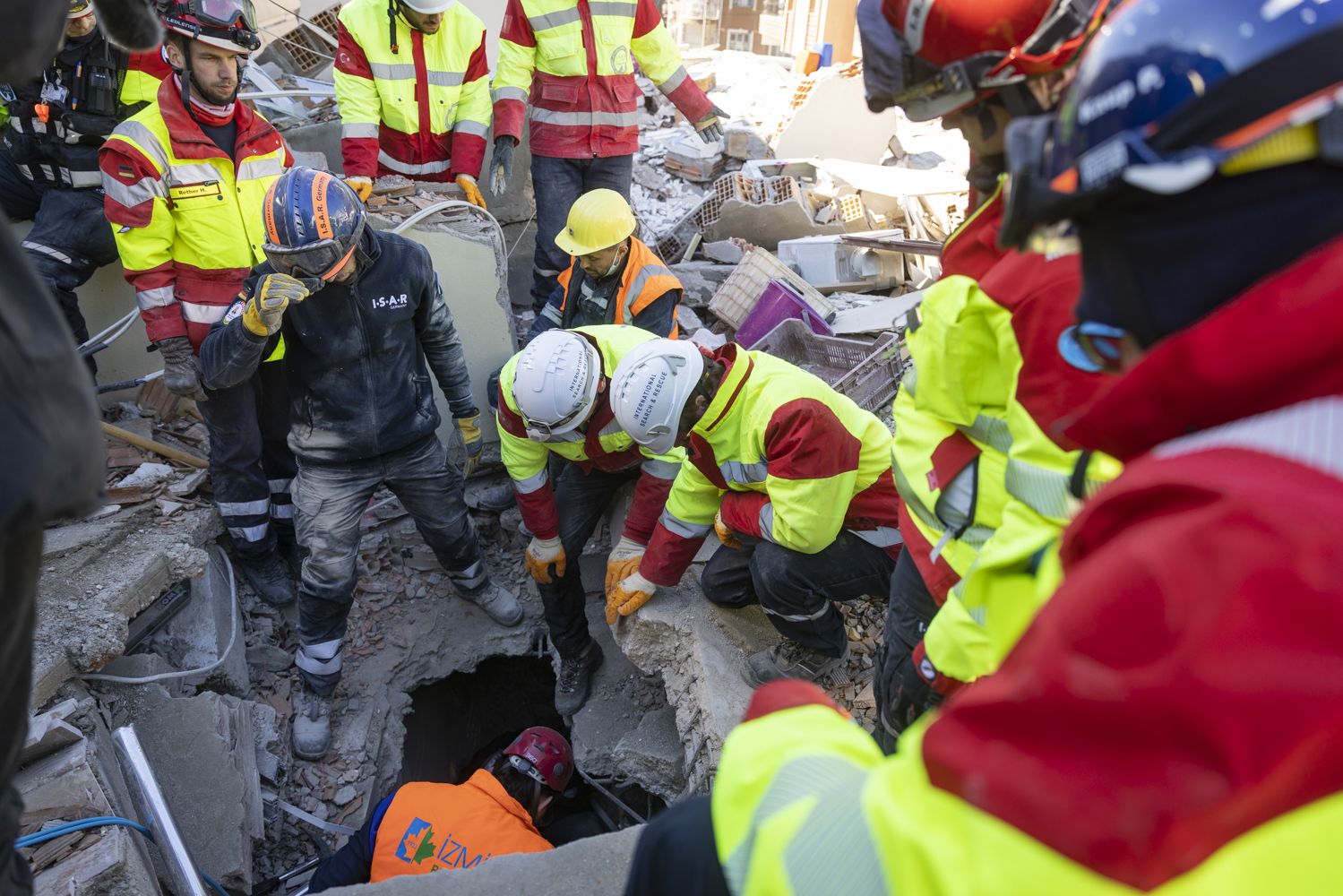
The demonstration scenario focuses on the immediate need for robust, secure, and reliable communication (SATCOM is essential!) to coordinate Urban Search & Rescue (USAR), evacuation efforts, and the delivery of basic supplies (food, water, fuel).
During demonstrations we will establishing communication between the Mission Control Center (MCC), deployed multinational first responders (like I.S.A.R. Germany), and the affected public/media for coordinated rescue and aid distribution. We will also provide secure, direct satellite communication links between a maritime humanitarian aid vessel (in this case the Spanish research vessel “Sarmiento de Gamboa” bringing supplies and offering evacuation) and the Base of Opeartions (BoO) /MCC to coordinate logistics and patient transfers to Vigo, Spain.
The success of our mission hinges on maintaining integrity and availability of communications under extreme conditions, overcoming long distances, and compensating for the total collapse of local infrastructure.


Validating and enhancing the GEXTRECS solution
together with GOVSATCOM End-Users and Stakeholders
Demonstrations are powerful tools for enhancing the effectiveness of knowledge sharing, especially with regard to tacit knowledge that requires direct interaction and experience. They provide a unique practical possibility to understand how something works and, at the same time, learn how to do something.
Live demonstrations are at the centre of GEXTRECS to:
- validate concepts, components and processes in near real-life situations,
- catalyse interdisciplinary collaboration and mutual learning within the project team,
- facilitate deeper engagement with the topic to meet the actual needs of End-Users,
- raise awareness on advantages and limitations of technological solutions, and
- foster collective action of a diverse range of stakeholders.
Lessons learnt from demonstrations will inform the development of a GOVSATCOM Crisis Management Service Pack Roadmap. This roadmap will define a technology-driven approach to closing the technical, operational, and security gaps highlighted by stakeholders.
In addition, the demonstrations will provide valuable insights to inform policy recommendations—particularly regarding the need for adaptable regulations and legal structures to enable technological and operational progress based on GOVSATCOM use cases in massive crisis management.